
Peregrine field notes
From PowerPoint to pixel-perfect PDF: a proposal renderer that never re-types data
A custom HTML/CSS template engine reads a client's record directly and renders a fully branded, flexible-length PDF proposal - matching the existing deck pixel-for-pixel, with zero re-typing.
TL;DR
A Sydney catering company was building every client proposal by hand in PowerPoint - copying prices out of spreadsheets, re-typing the same terms, and losing hours every time a client asked for a tweak. We replaced that routine with a simple system: pricing and proposal content are written once and stored in one place, and a fully branded, print-ready PDF is generated on demand. No re-typing, no version chaos, no design drift. The same approach works for any business that lives and dies by quotes and proposals.
The bottleneck: proposals held together by copy and paste
This was a real, growing hospitality business - but the sales process ran on manual effort:
- Every enquiry meant hand-building a PowerPoint deck, slide by slide.
- Prices were copied from spreadsheets into slides - and when a package changed, someone had to hunt through old decks to update them.
- There was no single source of truth for what a client had actually been quoted.
- Every revision meant another rebuild - and another chance for last month's prices to sneak back in.
The visible cost was time. The hidden costs were worse: proposals went out later than they should have, branding varied from deck to deck, and every so often a genuinely expensive error slipped through - like a per-guest price getting billed once instead of seventy times.
That's the small-business tax: real revenue, held together by manual effort that doesn't scale.
The fix: write everything once, generate the document
The replacement system has four parts - deliberately kept separate, so nothing is ever typed twice. (And importantly: this isn’t a “build it yourself in a weekend” project - the value comes from having the templates, rules, and data structure set up properly once, then running quietly in the background.)
| Piece | What it is | What it replaced |
|---|---|---|
| The price list | Every package, fee and add-on, written once | Prices copied and re-copied across dozens of old decks |
| The client card | One record per client and event - details, quote, totals, proposal number | Scattered spreadsheets and email threads |
| The content library | Pre-written, pre-approved proposal sections (intro, menus, terms) as swappable modules | Re-writing the same copy into every new deck |
| The template | The company's signed-off design, built once | Starting the layout from scratch every time |
Putting together a proposal now means attaching the right modules and a quote to a client card. Nobody types into the document at all. Change a price once in the list, and it's correct on every future proposal automatically.
Two details make it feel enterprise-grade:
- Automatic numbering and revisions. Every proposal gets a sequential reference number. If the quote changes, the same document is regenerated as “-R2” - not saved as final_FINAL_v7.pptx.
- Rules that prevent mistakes. Deposit percentages, bond tiers and tax are calculated live from the quote total - nobody works out 25% by hand. And packages are tagged by event type, so a client is never offered something that doesn't apply to their event.
There's even the option to have an AI agent build the quote itself: a two-minute guided conversation that asks the right questions, offers only valid packages with live pricing, and writes the line items once the client confirms.
How it works, in plain English
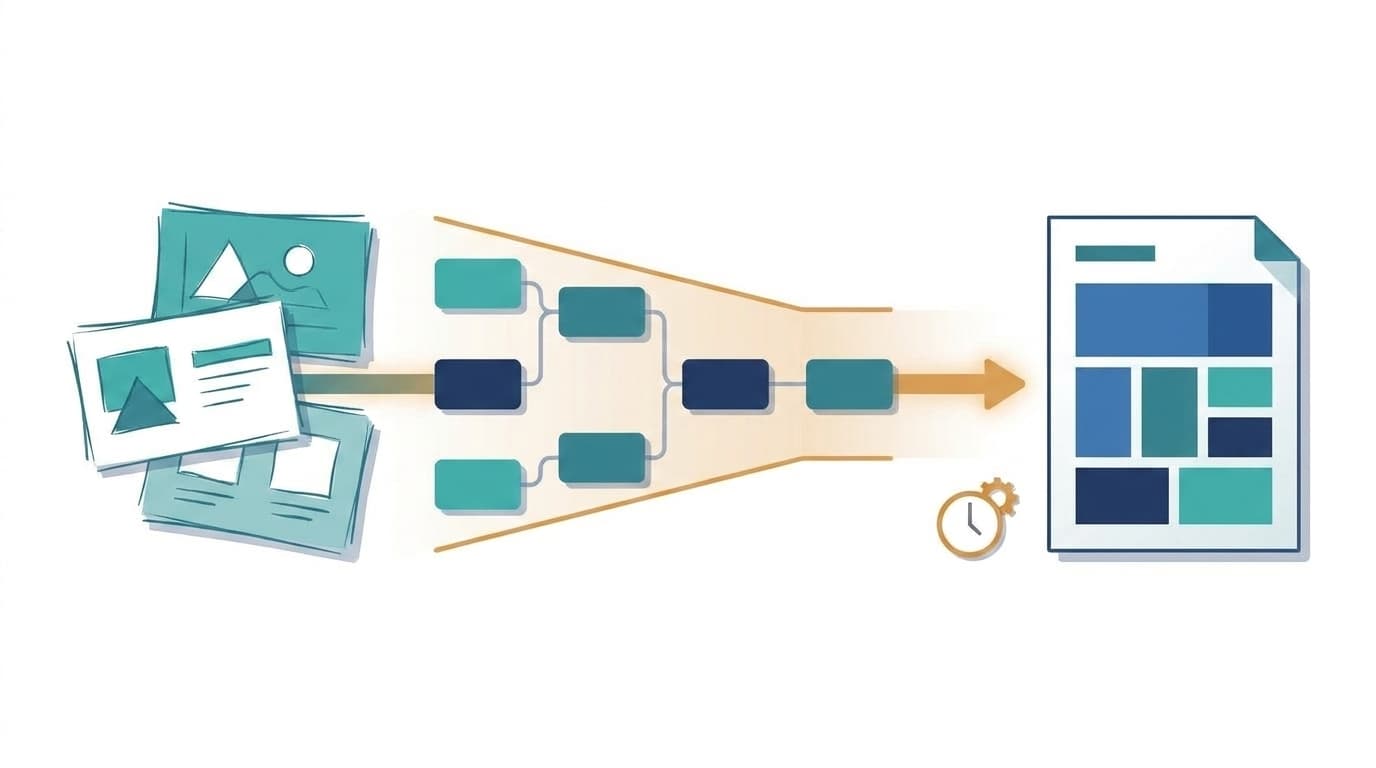
The key idea: the proposal isn't a file someone edits - it's a template filled with live data.
The pricing, content and client details live in the business's workspace (in this case, Notion). When a proposal is needed, the system combines that data with the design template and renders a finished document - a print-ready PDF or a private web link - in seconds.
Because the document is generated from the record every time:
- The branding is identical on every proposal - fonts, colours and layout are locked in.
- The page count flexes to the job - a simple event might need 3 pages, a wedding 12 - and optional sections only appear when they're relevant.
- The numbers on the document always match the numbers in the system. There's nothing to copy, so there's nothing to mistype.
Under the bonnet it's built with standard web technology - the same stuff websites are made of - which is exactly why the design can be matched pixel-for-pixel. But nobody using the system ever touches that layer.
The result
- Typically far cheaper than enterprise quote/proposal stacks because it reuses the tools you already have (plus a lightweight rendering service), instead of adding a full CPQ/CRM suite just to generate documents.
- Manual typing and copy-pasting: eliminated. Every figure on a client-facing document comes straight from the single record.
- The whole sales loop happens in one tool - quote, priced proposal, sendable document - instead of switching between a CRM, a slide deck and email.
- Revisions are trivial. “Can you tweak the package and resend?” is a re-render, not a rebuild - and the audit trail stays clean.
This mirrors what wider industry research finds: organisations using CPQ systems (which automate quoting/proposals) tend to see shorter sales cycles and higher proposal volume.[1]
The deeper benefit is harder to screenshot: proposals go out the same day, follow-up is faster, and the business simply sends more proposals than it used to.
Could this work in your business?
This kind of system pays for itself fastest when a few things are true:
- Your proposals follow a repeatable shape - even if the content varies, the structure doesn't.
- Your pricing can live in one maintained list - and someone's responsible for keeping it current.
- Client and job details live in one place (or you're willing to adopt one - we typically use Notion for this).
- Your rules can be written down - deposits, tax, what's included at each tier.
- There's enough volume - or enough pain per mistake - to justify the setup.
One honest caveat: automation locks in whatever you feed it. If the underlying pricing or client data is a mess, the first job is tidying that - otherwise you just make the mess faster.
Q&A
How can a business auto-generate branded PDF proposals without rebuilding them each time?
Keep the proposal content as structured data (a price list, a client record, pre-written sections) and the design as a reusable template. The system combines the two and generates a fresh, branded PDF whenever you need one - so nothing is ever re-typed and the design never drifts.
What tools do I need to generate PDFs automatically?
At minimum: (1) a data source (Notion or your CRM), (2) a reusable template (your signed-off proposal design), (3) a renderer that turns the template + data into a PDF, and (4) a delivery method (a private link or stored PDF). The best setups also include versioning (proposal number + revision) and rules/validation so the quote can’t contain invalid combinations.
Will the generated proposal really match our existing design?
Yes. The template is built to replicate your signed-off design - fonts, colours, spacing and layout - so the output looks like it came from your designer, not from a mail merge.
What if proposals are longer for some clients than others?
That's handled by the template: optional sections only appear when they're relevant, so the document grows or shrinks to fit the job without breaking the layout.
How do revisions work?
Update the details in the record and re-generate. The proposal keeps its reference number and gains a revision suffix (-R2, -R3), so there's a clean history and no “final_FINAL_v7” files.
Want this without the DIY?
If proposals or quotes are a bottleneck in your business, that's exactly what we build. Peregrine Automations can map your current workflow, design the template to match your brand, connect it to your data, and automate the numbering, revisions and delivery.
Book an Automation Audit via https://www.peregrineautomations.com.au/contact - or pressure-test the business case first with our ROI calculator.
About Peregrine Automations: We build custom “invisible” automations for Australian small businesses - connecting the tools you already use to remove double entry and speed up follow-up.